The call usually goes something like this. It rained hard overnight, there’s a brown ring on the ceiling near the family room wall, and from the backyard the tiles look perfectly fine. When we get up there, the tiles often are fine. The problem is the strip of metal where the roof meets a wall, a chimney or a pipe. That strip is the flashing, and roof flashing repair is one of the most common fixes we do on homes around Narre Warren.
This guide covers what flashing actually is, why it gives up, how to spot the signs from the ground, and what a proper repair looks like compared with a quick dab of sealant.
Flashing is the seal at every join in your roof
Tiles and metal sheets are very good at shedding water across an open surface. Where they struggle is at the joins: the spot where the roof runs into a brick wall, the four sides of a chimney, the hole cut for a vent pipe, the edge of a skylight. Flashing is a shaped strip of metal or flexible material that covers each of those joins so rain runs over it and away, instead of into the gap.
On the homes we work on, you’ll usually find a few different kinds:
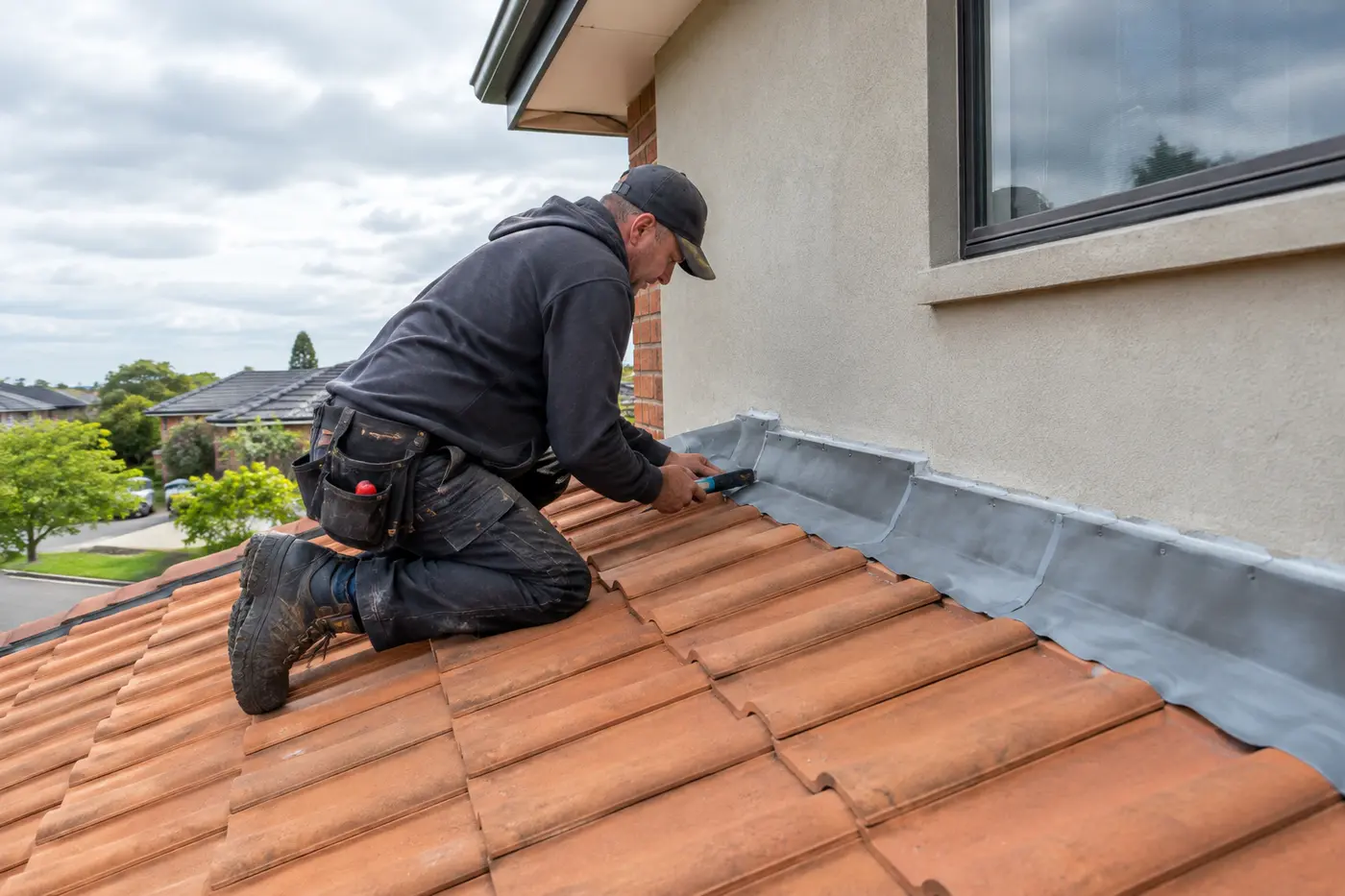
- Apron flashing where a lower roof meets a wall, such as a single storey section tucked under a double storey, or a carport tied into the house.
- Step and counter flashing up the sides of chimneys and walls. The counter flashing is the top piece, often tucked into a mortar joint in the brickwork.
- Penetration flashing around vent pipes, flues, aerials and solar mounts. On Colorbond roofs this is often a rubber boot that hugs the pipe.
- Barge and gable flashing, the folded metal along the sloping edges of a metal roof.
Roof valleys are flashing too, technically, but they behave differently enough that we’ve written a separate guide on valley iron problems and how they’re fixed.
Why flashing lets go
Flashing rarely fails in one dramatic moment. It’s usually a slow process, and the cause is often something that was done years earlier.
Houses move. Timber frames shrink and swell with the seasons, and the brickwork shifts at a different rate to the roof. Over time that movement cracks the mortar that holds counter flashing into the wall, and the top edge starts to pull away. Once there’s a gap, wind driven rain finds it.
Silicone is the other big one. A lot of the leaks we chase trace back to a previous patch job where someone ran a bead of sealant along a lifted flashing. It works for a while. Then the sun cooks it, it shrinks and splits, and because it was the only thing holding the seal together, the leak comes back worse.
Other causes we see regularly:
- Old galvanised flashing that has rusted through, especially where leaves sit against it
- Fixings backing out after years of the metal expanding and contracting
- Storm winds lifting a loose edge and folding it back
- Extensions and pergolas where the new roof was never properly flashed into the old wall
- Lead flashing draining onto a Colorbond or Zincalume roof, a pairing the metals don’t tolerate, so the sheet below corrodes
The water stain is rarely right under the fault
This catches people out. Water that gets past a flashing will often run along a batten or rafter before it drips, so the stain on your ceiling can be some distance from where the water got in. That’s why flashing leaks get mistaken for cracked tiles, and why replacing a few tiles sometimes changes nothing.
Things worth looking for:
- Stains or bubbling paint on ceilings near an outside wall, chimney or where a lower roof meets a higher one
- Damp patches on an inside wall directly under a second storey
- Flashing you can see sitting proud or lifted from the ground
- Rust streaks running down from a flashing onto the tiles or sheets
- Cracked or missing mortar along the top edge of a wall flashing
- A leak that only shows up when rain comes from one direction
That last one is a strong hint. Ordinary rain runs straight over a tired flashing, but a southerly change pushes water sideways into the gap. If your leak is fussy about the weather, flashing is high on our list. If you’re still not sure where to start, our guide on working out why a roof is leaking walks through the other usual suspects.
A tube of silicone is not a repair
When we’re up on a roof looking at a failed flashing, there are really three ways it can go.
Refix and reseal
If the metal itself is sound and just lifted, we clean it back, refix it mechanically so it stays put, and seal it with a product made for roofing. On wall flashings that usually means raking out the old mortar joint and repointing it so the top edge is held properly. The fixings do the holding. The sealant is a backup, not the whole job.
Replace a section
Where one stretch has rusted or been bent by wind, we cut out the bad length and fit new flashing that laps correctly over what’s left. On metal roofs we match it to the roof colour so it doesn’t stand out from the street.
Replace the lot
Some flashings are too far gone to patch. Rusted galvanised steel, lead that’s been cracked and resealed over and over, or a carport junction that was never flashed properly in the first place. In those cases replacing the flashing outright usually works out cheaper over a few years, because you stop paying for the same leak twice. On tile roofs we often use flexible flashing, which moulds to the tile profile and sits tighter than older rigid strips.
We’ll tell you which of the three your roof needs and why. Sometimes the honest answer is the small one.
Why we’d steer you away from doing it yourself
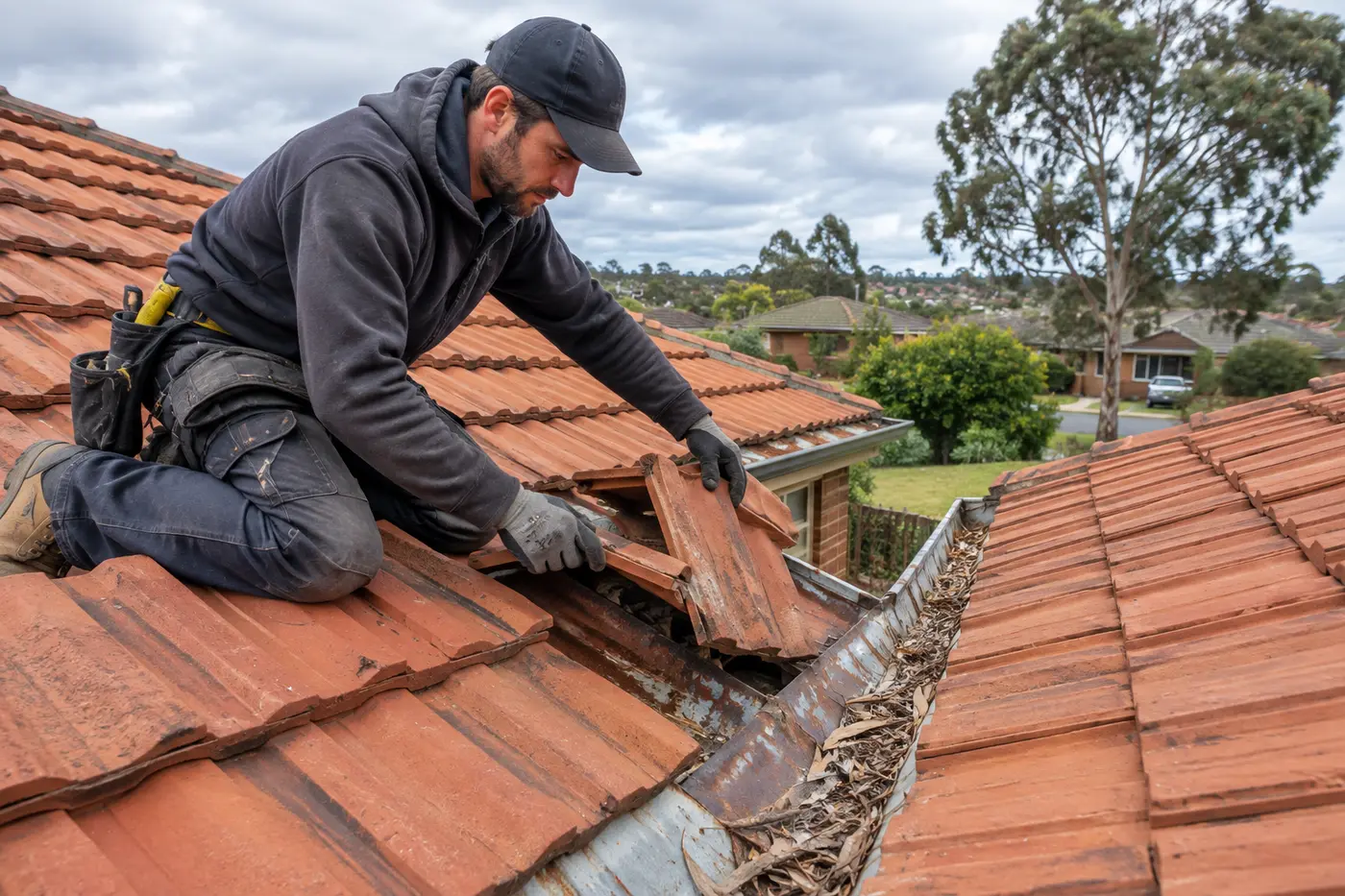
Flashing faults sit in the most awkward parts of a roof: against walls, around chimneys, on second storey junctions. Walking on tiles without knowing where to step cracks them, which gives you a new leak on top of the old one. And a lot of the DIY repairs we come across have too much sealant in the wrong place, which can trap water behind the flashing instead of keeping it out.
Clearing leaves from around a flashing with a blower from a safe spot is fine. Anything that involves climbing up, lifting or refixing metal is a job for a licensed roofer with the right safety gear.
What happens when you call us
Every flashing job starts with a free inspection. Cam or one of the crew gets up on the roof, finds where the water is actually getting in (which isn’t always where you’d expect), and shows you what we found. You get a clear quote with the options laid out, and the work is covered by our 10 year warranty on workmanship and products.
If we’re already on your roof for a restoration, we check every flashing as part of the job. There’s little sense coating a roof and leaving a tired flashing in place to leak under fresh paint.
Common questions about roof flashing
Can roof flashing be repaired, or does it always need replacing?
Plenty of flashing can be repaired. If the metal is sound and has just lifted or lost its seal, refixing and resealing it properly will usually do the job. Rusted, cracked or badly installed flashing is better replaced, because patching it tends to fail again.
What do roofers use to seal flashing?
The main thing holding a flashing in place should be mechanical: screws, rivets or a repointed mortar joint. On top of that we use sealants made for roofing that handle UV and movement. Household silicone on its own breaks down in the sun and is behind a lot of repeat leaks.
How long does roof flashing last?
It depends on the material, how well it was installed and what it’s exposed to. Galvanised steel sitting under wet leaves will rust out far sooner than colour matched steel or flexible flashing on a clean roof. The quality of the original install matters as much as the material.
How expensive is a roof flashing repair?
The price depends on where the flashing is, how much needs work and whether it can be refixed or has to be replaced. A single lifted section is a very different job to reflashing a whole chimney on a steep roof. We give free inspections and quotes so you know the real number before anything starts.
Can I replace roof flashing myself?
We don’t recommend it. Flashing usually sits in the hardest and riskiest parts of the roof to reach, and getting the overlaps wrong sends water in rather than out. It’s also easy to crack tiles getting to it.
Should flashing be replaced during a roof restoration?
Not automatically, but every flashing should be checked and fixed where needed. Sound flashing can stay. Anything rusted, lifted or held together by old sealant should be dealt with before the roof is coated, otherwise you’re painting over the next leak.
What is the flashing around the roof called?
It depends on where it sits. Apron flashing runs where a roof meets a wall, step and counter flashing go up the sides of chimneys and walls, barge flashing caps the sloping edges of metal roofs, and valley iron runs where two roof slopes meet.
Got a stain near a wall or chimney that keeps coming back after rain? Book a free inspection and we’ll find where the water is getting in. If the flashing is past saving, our flashing replacement service covers tile and metal roofs across Narre Warren and the surrounding suburbs.