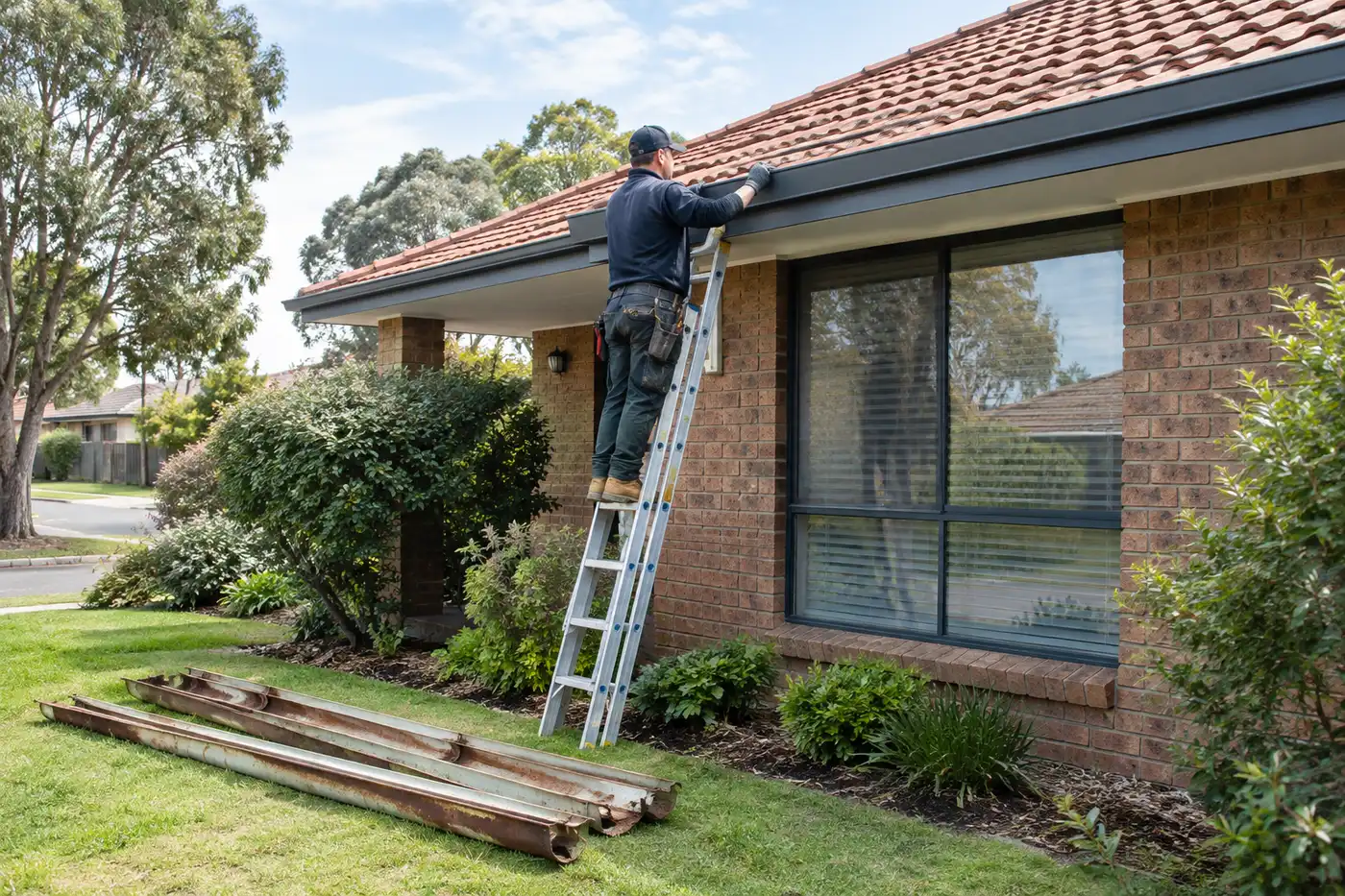
It usually starts with a downpour. Water sheets over the front gutter instead of running to the downpipe, someone climbs a ladder the next weekend, and they find a line of rust holes along the bottom of the gutter and an old patch that has finally let go. The first question on the phone is always the same: what is gutter replacement cost going to look like for my house? It’s a fair question, and the honest answer is that it depends on a handful of things you can check yourself before anyone quotes. This guide walks through them, so the number you get makes sense and you can tell a good quote from a thin one.
Why nobody can price your gutters honestly over the phone
Gutters look simple from the street. Up close, every house is different. Two homes in the same Narre Warren South estate can have very different jobs once you count the corners, the downpipes, the height at the back and the state of the timber behind the gutter.
That’s why we measure first. Our inspections and quotes are free, and we’d rather spend half an hour on site than give you a phone figure that changes once the old gutter comes off. Any quote worth trusting should be built from your actual roof, not an average pulled from the internet.
Length sets the baseline, but corners add up
Gutters are priced mostly by the metre, so the total run around your roof is the starting point. A simple rectangular house has four corners and a short perimeter. A house with an L shape, a garage, a porch and a back extension can easily have double the corners and a much longer run.
Each internal or external corner is a joint that has to be cut, mitred and sealed properly. Stop ends, outlets (the pops that connect the gutter to each downpipe) and joiners are all small parts, but they take time to fit well, and badly sealed joints are where most gutters start leaking. More corners means more of that work.
Profile and material change the number
The gutter profile is its shape. Most homes around here have one of a few common types:
- Quad, the curved front profile on a huge number of Victorian homes
- Square line or similar box shaped fronts on newer builds
- Half round, often on older or heritage style houses
- High front or fascia gutters, which replace the fascia board and give a cleaner roofline
Some profiles carry more water than others, and some are simply more common and quicker to install. If your house has an older or unusual profile, matching it can take more effort, and sometimes the better call is to change profile across the whole house so it looks consistent.
Material matters too. Colorbond steel is what we fit most often because it comes in colours that match Colorbond roofs, fascias and trims, and it holds up well in Melbourne weather. Plain zincalume is another option. Choosing a colour to match your roof or your trims doesn’t usually change the price much, but it’s worth deciding before the quote so the materials are ordered right.
Height and access cost more than most people expect
This one surprises people. A single storey house on a flat block with clear paths is straightforward. A double storey house, a sloping block where the back is a full storey higher than the front, or a narrow side path packed with water tanks and air conditioner units all slow the job down.
Working at height also means proper safety gear, and on taller homes that can mean edge protection or scaffolding. It isn’t optional and it isn’t padding: it’s how the crew gets home safely and how the job stays compliant. If one quote is much cheaper than the others on a double storey home, ask how they plan to work safely at the second level.
What’s hiding behind the gutter can change the job
The gutter hangs off the fascia, the board that runs along the edge of the roof. When a gutter has been leaking for years, the water often soaks into a timber fascia and rots it. You can’t always see that from the ground. It shows up when the old gutter comes off and the screws pull straight out of soft wood.
Rotten fascia has to be repaired or replaced before new gutters go on, otherwise the new brackets have nothing solid to hold. A good quote tells you upfront how this will be handled if it’s found: whether it’s included, or priced per length, so you’re not caught out halfway through the job. We also check the fall, which is the slight slope that sends water to the outlets. Gutters that hold puddles rust faster, so getting the fall right is part of doing the job properly, not an extra.
Downpipes and where the water goes next
New gutters on top of rusted, split or undersized downpipes is half a job. Most quotes will either include replacing the downpipes or list them as an option, and the number of downpipes on your house makes a real difference to the total.
Sometimes the gutter isn’t the real problem at all. If water backs up and overflows near a downpipe, the blockage may be in the downpipe or the stormwater pipe underground. We’ll tell you if that’s what we find, because replacing a sound gutter won’t fix a blocked drain.
Repair a section or replace the lot?
Not every gutter problem needs a full replacement. If one length has rusted through above a tree that drops leaves into it, and the rest is solid, replacing that section can be the sensible fix. Leaking joints can often be resealed, and a sagging run sometimes just needs new brackets. Our gutter repair service covers exactly these smaller jobs, and we’ll say so if a repair is all you need.
Full replacement makes more sense when rust shows up in several places, when old patches keep failing, or when the profile has been discontinued and a new section would never quite match. Patching an old system over and over usually costs more in the end than replacing it once.
One more thing worth ruling out: overflowing gutters aren’t always worn out. If they spill in heavy rain but have no rust or holes, they may simply be full of leaves and silt. Our guide to keeping gutters clear in Narre Warren explains what a proper clean involves and how often homes under big trees need one.
Planning roof work? Do the gutters at the same time
If a roof restoration or a new roof is on the cards in the next year or two, it’s worth timing the gutters with it. The crew, the safety setup and the access are already in place, so you’re not paying for all of that twice. It also lets the new gutters match the roof colour from day one.
If you’re weighing up a full re-roof, our breakdown of what sets the price of a new Colorbond roof covers how gutters and trims fit into that bigger quote.
How to compare two gutter quotes fairly
Quotes that look far apart are often just covering different things. Before you pick the cheaper one, check that both include the same items:
- Total metres of gutter, and the profile and material
- Removal and disposal of the old gutters
- New downpipes, or reuse of the old ones
- How rotten fascia will be handled if found
- Safety equipment for second storey or steep areas
- Colour, and whether it matches your roof or trims
- Warranty on the work and the materials
If a quote is a single line with one total and no detail, ask for a breakdown. A roofer who has actually measured your house can give you one easily.
Straight answers about gutter replacement cost
How much does it cost to replace guttering on a house in Australia?
It depends on the metres of gutter, the profile and material, how high the roof is and whether the fascia and downpipes need work too. National averages online can be a long way off for your house. A free on site measure and quote is the only way to get a figure you can actually rely on.
What is the average cost per metre for Colorbond guttering?
Per metre prices you see online usually cover the gutter itself, and often leave out removal of the old gutters, downpipes, corners, fascia repairs and safety equipment. Those extras can make up a big part of the final bill. When you compare per metre rates, always ask what’s included.
How much does it cost to replace a length of guttering?
Replacing one section is usually much cheaper than the whole house, as long as the rest of the system is sound. The catch is matching the profile and colour of older gutters. If your profile is no longer made, a single new length can look out of place, and that’s when a full run starts to make more sense.
What are the downsides of using gutter guards?
Gutter guards cut down on leaves, but they don’t stop fine silt, seeds and grit, so gutters still need checking and cleaning. Debris can also sit on top of the mesh and block water in heavy rain. They help on homes under big trees, but they aren’t a substitute for gutters that are in good condition and properly sloped.
Should I replace my downpipes when I replace my gutters?
If the downpipes are rusted, split or too small for the roof area, yes, it’s best to do them together. It costs less than coming back later, and it means the whole system is new at the same time. If they’re in good shape, a good roofer will tell you they can stay.
Get a gutter quote that adds up
If your gutters are rusting, sagging or spilling over, we’ll come out, measure everything and give you a clear, itemised quote with no obligation. Our work comes with a 10 year warranty on workmanship and products, and if a simple repair will do the job, we’ll tell you. Book a free inspection with Cam and the crew through our gutter repairs and replacement page.